
Neomind Learning partnered with Touchstone Research to put its AI tutor app in front of real students and make it better across two rounds of testing. The first was a full-service diagnostic that established a clear baseline of how students ages 12 to 18 actually experienced the platform. Neomind acted on what they heard, and a leaner flex-service follow-up confirmed the changes worked, with student satisfaction rising meaningfully between rounds and Net Promoter Scores reaching very strong levels.
AT A GLANCE
| CLIENT | Neomind Learning |
| INDUSTRY | AI Personal Learning Intelligence | EdTech |
| USE CASE | Beta validation and iterative refinement of a human-like AI tutor app |
| AUDIENCE | Students ages 12 to 18 across the U.S., currently taking math |
| METHODOLOGY | Two-phase research: full-service diary and focus groups, then a flex-service follow-up test |
| ENGAGEMENT | Full service (Phase 1) and flex service (Phase 2) |
| OUTCOME | Measurable improvement in student satisfaction across rounds |
The Challenge
A student stuck on a tough math problem at night doesn’t usually have a tutor on call. Neomind Learning is building one: an AI tutor that supports students the way a good human tutor would, truly understanding students goals and gaps, helping concepts click, adapting approach, and being available whenever they need it. But a tutor built for young learners only earns its place if students trust it and keep coming back.
Before scaling the product, Neomind wanted an honest read on how it was actually landing with students: what won them over, what frustrated them, and what would bring them back. Testing a learning product with minors raises the bar. The feedback has to be real, the recruitment rigorous and compliant, and the research has to show not just whether students liked the app, but precisely where the experience worked and where it broke down, so the team could act on it. Neomind also wanted a partner who could scale the engagement to the moment: a deep, comprehensive read first, then a faster, focused check once changes were made.
The Approach
We designed a two-phase, iterative UX research program built to move at the pace of product development.
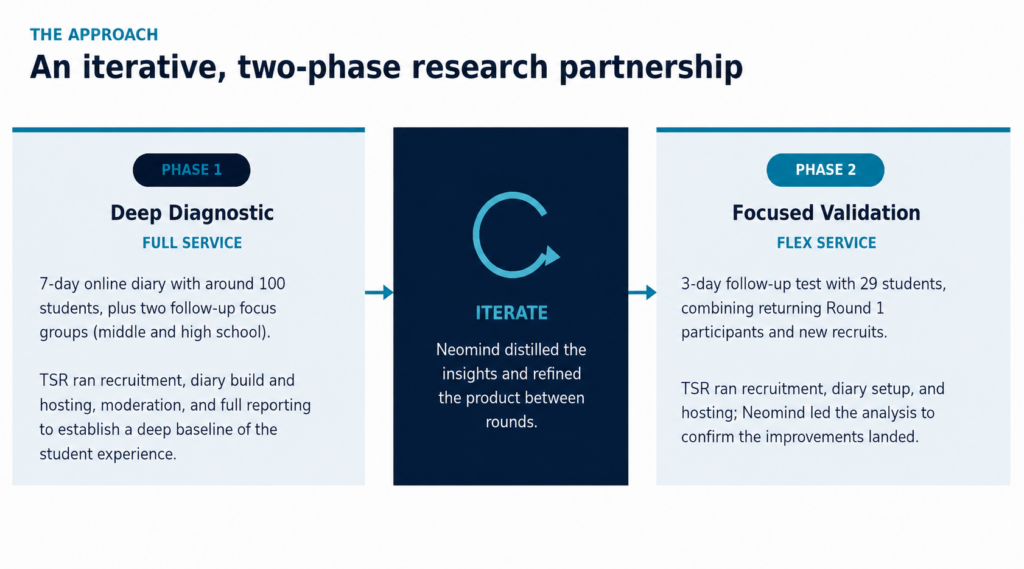
Phase 1: a deep, full-service diagnostic
A 7-day branded online diary put the learning platform in students’ hands at home, capturing their reactions day by day as they set up the tutor, sat through live classes, and worked through quizzes. Two follow-up focus groups, one middle school and one high school, added the why behind the what. Touchstone ran the full stack: recruitment and multi-stage screening, diary build and hosting, discussion guide development, moderation, and a complete reporting and analysis deliverable. The result was a clear, structured picture of the whole student experience, start to finish.
Phase 2: a focused, flex-service validation
Once Neomind acted on the findings, a leaner 3-day follow-up test checked whether the changes worked. This round deliberately brought back students from Phase 1 alongside fresh recruits, so the research could see whether the improvements actually moved the needle. Here Touchstone shifted to a flex-service model, handling recruitment, diary setup, hosting, and incentives, while Neomind led the final analysis. Because the follow-up used the same core metrics as Phase 1, any movement in the numbers reflected real change in how students experienced the product.
Together, the two phases show how we like to partner: a deep, full-service foundation when a client needs the complete picture, and a nimble, flex-service model when they need a fast, focused answer. The engagement met the product where it was at each stage.
The Impact
The iterative approach produced measurable improvement. Between the first and second tests, student sentiment rose meaningfully, reaching levels that were particularly impressive for such young product in a new category that Neomind is defining, what they call the Personal Learning Intelligence.
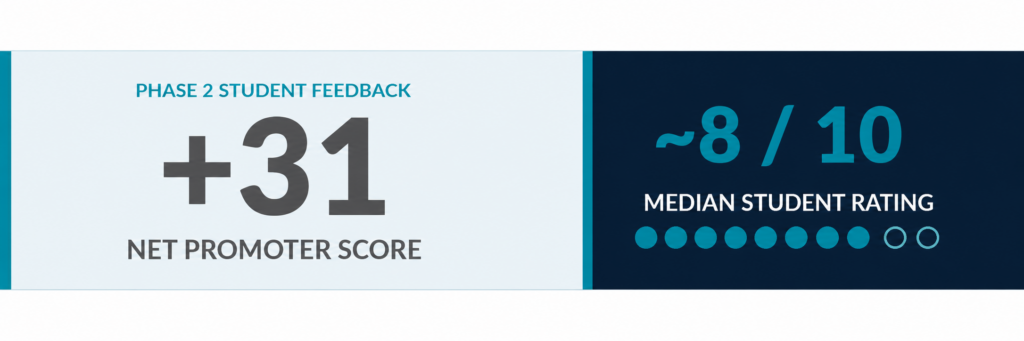
The gains came straight out of how the two teams worked together: run a test, make sense of what students said, change the product, and test again. Instead of treating research as a one-time report that lands and gathers dust, Neomind and Touchstone ran it as a loop, turning student feedback into real product changes and then checking that those changes resonated. That back-and-forth is what moved the numbers.
Client Voice
“Working with Touchstone felt like having an extension of our own team. They invested significant time upfront to understand our product and objectives, and they approached the project with great attention to detail. Their responsiveness, flexibility, and commitment to helping us succeed made them an invaluable partner as we refined the product and prepared for the next stage of growth.“

Felipe Hildebrand – CEO, Neomind Learning
Frequently Asked Questions
Why Touchstone Research
Touchstone Research is a strategic research partner with deep roots in youth, family, and Gen Z audiences. Founded in 1991, we bring together qualitative, quantitative, and UX research, in-house recruitment, and a flexible engagement model, from full-service studies to focused flex-service rounds, so the research can scale to whatever a product needs at each stage.
For teams building products for young people, we pair careful, compliant recruitment with the depth to show not just whether something works, but exactly where and why, and then help confirm the fixes landed.
Building a product for students, families, or young audiences? Contact our team of Youth & Family Research Experts
About The Author

Sheri Stark is a Senior Qualitative Researcher at Touchstone Research and the author of this case study. With nearly 20 years of experience spanning both B2B and B2C, she specializes in research with children, teens, and parents, and in usability and user testing for technology, social media, and retail brands. Her qualitative toolkit spans in-depth interviews, focus groups, diary studies, ethnographies, co-creation, and insight communities, the same hands-on methods that shaped the Neomind engagement.